Stadiums
Detroit City FC's $74.2M Brownfield Capture Is a 30-Year Reimbursement, and Half of It Is for Housing
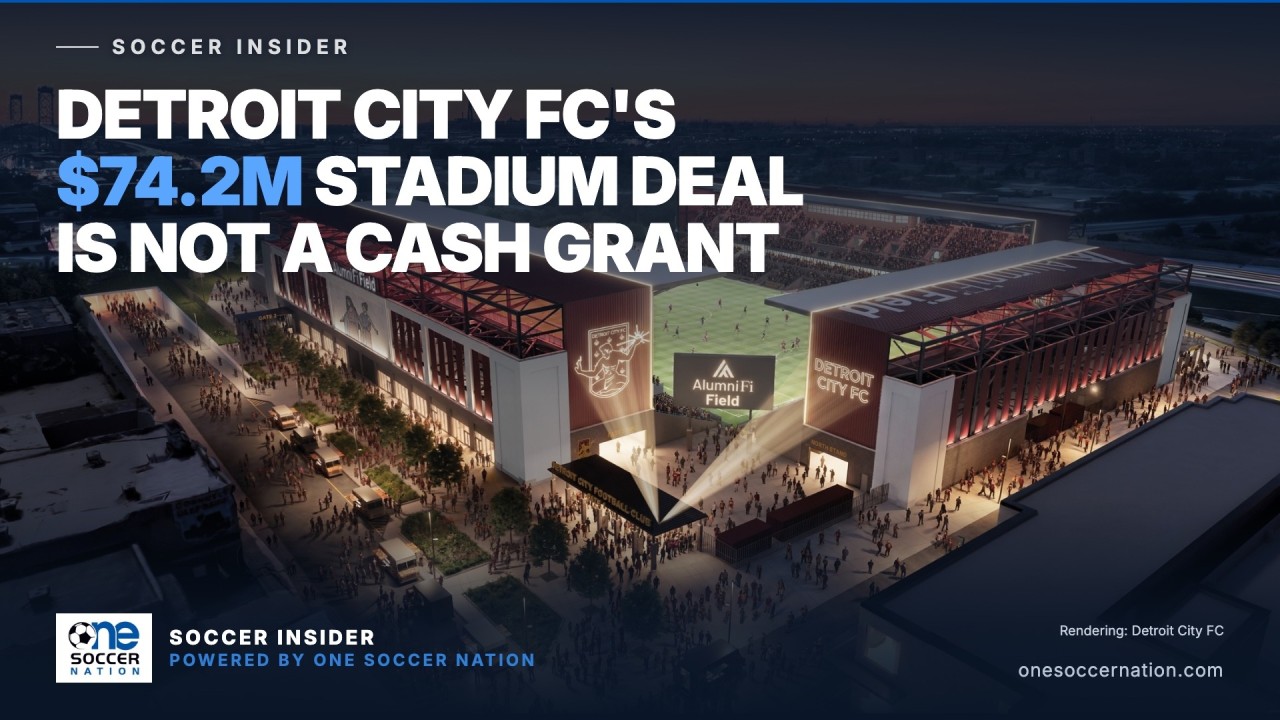
Detroit City FC's AlumniFi Field plan reimburses a developer up to $74,214,632 from property taxes captured over as many as 30 years, with no advance from the City. For anyone underwriting a brownfield-funded venue, the line items show what the money is made of and what must happen before it is paid.
The bottom line
- The $74,214,632 is paid only from captured property tax growth for up to 30 years, with no advances from the City or the Detroit Brownfield Redevelopment Authority (DBRA), so the club carries cost and timing first.
- About 49.9% ($37.0M) reimburses rent loss on affordable apartments and 23.6% ($17.5M) funds infrastructure including a $12.75M parking line, while demolition is $3.4M, or 4.6%.
- Payment is conditioned on work plan approvals from the Michigan Strategic Fund (MSF), EGLE and MSHDA within 270 days of Council approval, a window that ran to about 22 Aug 2026.
- No MSF action on the project appears in board packets through September 2026, and the only confirmed state money is a $1M EGLE grant announced 8 Oct 2026.
- With about $14M of reported tax breaks the public package is about $88M against a $198M project, roughly 44%.
The story
Club-affiliated companies bought the former hospital site at 20th Street and Michigan Avenue in March 2024. City assessor data records a $6.5M sale of the 2401 20th St parcel on 15 Mar 2024. The City describes the stadium as privately financed, owned and operated by the team.
The first plan covered demolition only, at $5,922,370 over 21 years, approved by Council in May 2025. The amended plan followed, adopted by the DBRA board on 8 Oct 2025 and approved by Council on 25 Nov 2025, per club and press accounts. It is more than 12 times the original.
Barton Malow was named construction manager on 24 Apr 2026, and the club moved the opening to spring 2028 on 16 Jun 2026. Ground was broken on 15 Jul 2026 for the 15,000-seat stadium.
What is working
The plan is public, itemized and advances no City cash.
- Every dollar of the $74.2M is itemized by activity in the DBRA transmittal packet, so any reader can test the composition.
- Reimbursement comes only from captured increment, so the City and DBRA carry no cash exposure if the campus underperforms.
- Delivery is visible: demolition is concluded, a construction manager is named, ground is broken, and the club reports more than 6,000 seat deposits.
The structure
The reimbursement follows the tax growth, so the club funds the work first
The plan captures property tax growth above the site's base value and pays it to the developer with no advances. CEO Sean Mann said in October 2025 that it is "all our own debt". On those terms the sum paid depends on the taxable value the completed campus produces.
The plan pays from growth that the build itself has to create.
- DEGC projects more than $14M in new City taxes over 30 years, and a developer return of 4.75% with incentives versus -0.13% without, per Crain's.
- The plan names 30 years as the maximum duration, so both the amount and the timing of payment depend on completion.
Housing is about half the capture and demolition is under 5%
The housing line reimburses rent loss over 30 years on 68 income-restricted units of 76 (8 at 60% and 60 at 80% of area median income), at up to $1,442 a month per unit.
Line items of the brownfield reimbursement for AlumniFi Field and the 20th & Michigan campus.
| Line item | Amount | Share of capture |
|---|---|---|
| Housing development activities | $37,021,320 | 49.9% |
| Infrastructure improvements (incl. $12.75M parking) | $17,529,815 | 23.6% |
| Site preparation | $9,160,800 | 12.3% |
| Department-specific environmental activities | $6,121,780 | 8.2% |
| Demolition | $3,405,417 | 4.6% |
| Assessments, due care, asbestos, plan preparation | $975,500 | 1.3% |
| Total reimbursement, up to 30 years | $74,214,632 | 100% |
- The infrastructure line includes $12.75M for structured parking, and $14.86M of it serves mixed use and parking rather than the stadium.
- The plan documents 76 units, while the club and EGLE now describe a 104-unit building, with no amended plan in evidence.
State sign-off is a stated condition, and the public record does not yet show it
Reimbursement is contingent on work plan approvals from MSF, EGLE and MSHDA within 270 days of Council approval. Bridge Michigan reported final authorization as contingent on MSF, while the club's release said "a state board" also approved. Full-text searches of MSF board packets from July 2025 through September 2026, including the September 2026 packet, found no match, though the November 2025 and July 2026 packets were not located.
- Whether the 270-day window was met, extended or lapsed is not disclosed.
- The $1M EGLE grant covers the mixed-use portion only, and EGLE is not MSF.
Private land and private debt leave two layers of the stack undisclosed
Land sits with club-affiliated companies, and no ground lease or reverter was found. About $88M of public incentives against $198M implies a private share of about 56%, though the debt lender, the debt amount and the Ronin Sports & Entertainment investment of 13 Jul 2026 are not disclosed.
- The $88M adds about $14M of tax breaks, of which $1.8M was approved and about $12M was reported as still being sought.
- Cost is $198M in the plan, $200M per the club and $190M per EGLE, which reflect different scopes and dates.
What would strengthen the case
- An MSF resolution or DBRA approval letters would confirm whether the 270-day condition was met, extended or waived.
- The DBRA reimbursement agreement would confirm payment timing and how housing rent loss is measured.
- An amended plan would confirm whether the housing line covers 76 or 104 units.
- The debt lender, debt amount and Ronin investment would size the private layers behind the capture.
The counterargument
The strongest case against the reimbursement framing is that captured increment is public revenue by another name. It is tax growth that would otherwise flow to the levying bodies for up to 30 years, and the projected -0.13% developer return without incentives implies the campus depends on it. Detroiters for Tax Justice, as reported by Field of Schemes, argues that "privately financed" understates this because the capture and abatements attach to the same campus. On that reading, "not cash" describes when the contribution arrives, not its size.
What to watch
- MSF board packets published after September 2026 for any action on the project.
- Any DBRA action on the 270-day work plan window that ran to about 22 Aug 2026.
- An amended plan reflecting the 104-unit building.
- The spring 2028 opening target, and the March 2029 housing occupancy date in EGLE's release.
- Disclosure of the Ronin amount, or of the debt lender and size.
The takeaway
Detroit City FC's $74.2M is a 30-year reimbursement from captured taxes, mostly for housing and infrastructure, and it pays out only if the campus's taxable value and the state approvals both arrive.
Sources
- Amended and Restated Brownfield Plan, 20th & Michigan Ave (transmittal packet to City Council, Exhibit A, Attachment E), Detroit Brownfield Redevelopment Authority, 17 Oct 2025 (pub-detroitmi.escribemeetings.com)
- Original Brownfield Plan for the 20th & Michigan Ave site, Detroit Economic Growth Corporation, Mar 2025 (degc.org)
- Parcel record for 2401 20th St (parcel 12007584.001), City of Detroit assessor open data, accessed Oct 2026 (services2.arcgis.com)
- Michigan Strategic Fund board packet, Michigan Economic Development Corporation, Sep 2026 (michiganbusiness.org)
- Press release on the 20th & Michigan brownfield project and $1M grant, Michigan Department of Environment, Great Lakes, and Energy, 8 Oct 2026 (michigan.gov)
- Detroit City Football Club Stadium community benefits engagement page, City of Detroit Planning and Development Department, accessed Oct 2026 (detroitmi.gov)
- Club release on the City Council approval of AlumniFi Field, Detroit City FC, 25 Nov 2025 (detcityfc.com)
- Club release naming Barton Malow as construction manager, Detroit City FC, 24 Apr 2026 (detcityfc.com)
- Club release on the AlumniFi Field preview center and project timeline, Detroit City FC, 16 Jun 2026 (detcityfc.com)
- Release on the groundbreaking of the HOK-designed AlumniFi Field, HOK, 21 Jul 2026 (hok.com)
- Club release on Jay Farner's investment in Detroit City FC, Detroit City FC, 13 Jul 2026 (detcityfc.com)
- Reporting on the stadium's community benefits agreement and incentive package, BridgeDetroit, 10 Oct 2025 (bridgedetroit.com)
- Reporting on Detroit's approval of tax breaks for two pro sports facilities, Bridge Michigan, 26 Nov 2025 (bridgemi.com)
- Reporting on the stadium campus's $88M public financing request, Crain's Detroit Business, 11 Sep 2025 (prod.crainsdetroit.com)
- Commentary on the Detroit City FC project (critic view, attributed in the article), Field of Schemes, 1 Dec 2025 (fieldofschemes.com)
Free Industry Report
2026 USL Championship Attendance: Down 7.5%
The USL Championship average fell to 5,148 per match while MLS and USL League One grew. We checked every club figure and found venue control, not market size, predicts crowds.
Read the Report