Stadiums
Hearts of Pine Didn't Buy a Stadium Site. They Bought a Regulatory Outcome.
Portland Hearts of Pine announced this week that it has agreed to acquire land at Cassidy Point, a coal storage terminal on the city's waterfront, to build a stadium seating 9,000 to 11,000 at a reported cost of around $50 million. Every outlet that covered it, from Maine Public to the Boston Globe, framed it the way the club framed it: three seasons of sellouts at Fitzpatrick Stadium, an 8,000-person waitlist, a club that has outgrown its rented home. That framing is accurate. It is also not the interesting part of this deal.
The interesting part happened a year earlier, when the Portland City Council passed an ordinance requiring coal to be under permanent cover by 1 January 2027, and banning the handling or storage of more than one ton of it in the city from the end of 2029. The rule was written broadly, but in practice it applies to exactly one site: the 45,000-ton coal pile Sprague Energy has stored at Cassidy Point, by far the city's largest. Sprague didn't ask for a soccer club. A citizens' initiative forced a public health fight, the council adopted the measure unanimously rather than send it to voters, and Sprague was left holding a terminal whose primary use had just been legislated into a multi-year wind-down.
That is the actual opening. Hearts of Pine didn't create a stadium deal by negotiating with the city for money. It walked through a door that a public health ordinance had already forced open.
The Deal Is a Land Story Wearing a Stadium Announcement
Every version of this story leads with capacity figures and renderings. The transaction underneath is simpler: an industrial landowner facing a forced operational wind-down sold (or agreed to sell) a piece of a waterfront parcel to a buyer who had spent years looking for exactly this kind of site. Founding partner Jonathan Culley confirmed the club has an agreement in place with Sprague, and declined to disclose the price. That is standard for a private real estate transaction. It is also the single biggest gap in evaluating whether this was a good deal, a fair deal, or an exceptional one.
The Site Is Being Bought in Pieces, Not Whole
Cassidy Point includes a 600-foot pier that supports active marine industrial use. That pier is explicitly carved out of this transaction. It stays zoned marine industrial and will continue to be run by a separate operator. (Sprague later agreed to sell the remaining acreage, pier included, to McAllister Towing, confirming the split.) Hearts of Pine is acquiring the buildable portion of the site, not the full parcel and not the working waterfront infrastructure attached to it. For a reader trying to comp this deal against other waterfront land transactions, that distinction matters more than the total acreage. A partial-use acquisition prices differently than a clean parcel, and it leaves the club with a permanent industrial neighbor on one edge of its stadium footprint.
The Ownership Group Had the Right Skill Set Already in the Room
Hearts of Pine's ownership includes Jonathan and Catherine Culley, principals of Portland real estate firm Redfern Properties, alongside founder Gabe Hoffman-Johnson and NESN broadcaster Tom Caron. Culley has said publicly that he and Hoffman-Johnson spent years searching the Portland peninsula for a site large enough for a stadium, a search that is genuinely difficult in a dense coastal city where 8-acre parcels are scarce. When the coal ordinance created a forced-seller situation, the buyer wasn't a club scrambling to solve a real estate problem for the first time. It was a club whose ownership group had been running that search as a standing mandate.
Nothing Here Has Closed
The club still needs a zoning change, a state environmental permit, and a traffic movement permit, through a public planning board process the city estimates will take roughly nine months. The developers are asking the city to rezone about 13.8 acres of the roughly 23-acre property, and waterfront workers and the port have organised against the change, arguing it would permanently remove deep-water property from the working waterfront. "Predominantly privately funded" leaves room for public money that hasn't been itemized yet, whether for infrastructure, parking, or transit access. And no source, including the club's own project page, addresses environmental remediation scope or cost for a site that has stored coal for decades. That is not a small omission for a $50 million-plus project with a 2027 construction target.
What This Signals About the Broader Strategy
Lower-division clubs have generally pursued stadium projects through one of two paths: negotiate public subsidy, or absorb the full cost of a greenfield build. Cassidy Point suggests a third path exists in dense, land-constrained coastal markets: position capital and relationships to move quickly when an unrelated regulatory action forces an incumbent industrial landowner to reconsider its holdings. That is not a strategy most clubs can execute. It requires ownership with real estate development experience already embedded in the group, a market where waterfront industrial land is genuinely scarce, and the patience to run a multi-year site search before any opportunity appears. Where those conditions exist, this model is worth watching. Where they don't, it isn't replicable by press release.
What Investors and Operators Should Watch
- Whether the final purchase price becomes public through Portland's planning board process, which would allow a real per-acre comparison against other waterfront transactions in the market.
- How the city allocates infrastructure costs (parking, transit, utilities) during the zoning and permitting process, since "predominantly privately funded" has room to shift.
- Whether environmental remediation costs and liability are disclosed, and whether they fall on the buyer, the seller, or a shared arrangement.
- Whether the marine operator retained on the pier creates any operational friction with match day logistics once construction begins.
- Whether other USL markets with similar land-constrained waterfronts see comparable regulatory actions create similar openings.
Final Thought
The stadium renderings are the least informative part of this announcement. The ordinance that preceded them is the part worth studying, because it shows an acquisition path that doesn't run through a city council subsidy vote. Whether that path is a genuine model or a one-market coincidence depends on details this announcement doesn't yet include.
Sources
- Portland Press Herald, "Hearts of Pine announce plan to build new stadium in Portland's West End," 4 Aug 2026
- Mainebiz, "Hearts of Pine unveil plan to build $50M soccer stadium in Portland"
- Maine Public, "Portland passes measure to ban waterfront coal stockpile," 26 Aug 2025
- Portland Press Herald, "Large coal pile on Portland waterfront could be removed by 2030," 25 Aug 2025
- Portland City Council adopts citizen proposal to mitigate coal dust pollution
- Mainebiz, "Portland soccer team to tackle zoning, permitting for stadium proposal"
- Portland Press Herald, "Portland waterfront workers question zoning change for Hearts of Pine stadium," 18 Aug 2026
- Island Institute, "Proposed soccer stadium sparks debate over Portland's working waterfront"
- Engineering News-Record, "Maine Pro Soccer Team Seeks to Build a Stadium Transforming a Fossil Fuel Site"
- Portland Press Herald, "Portland Planning Board kicks off Hearts of Pine stadium rezone debate," 22 Sep 2026
Free Industry Report
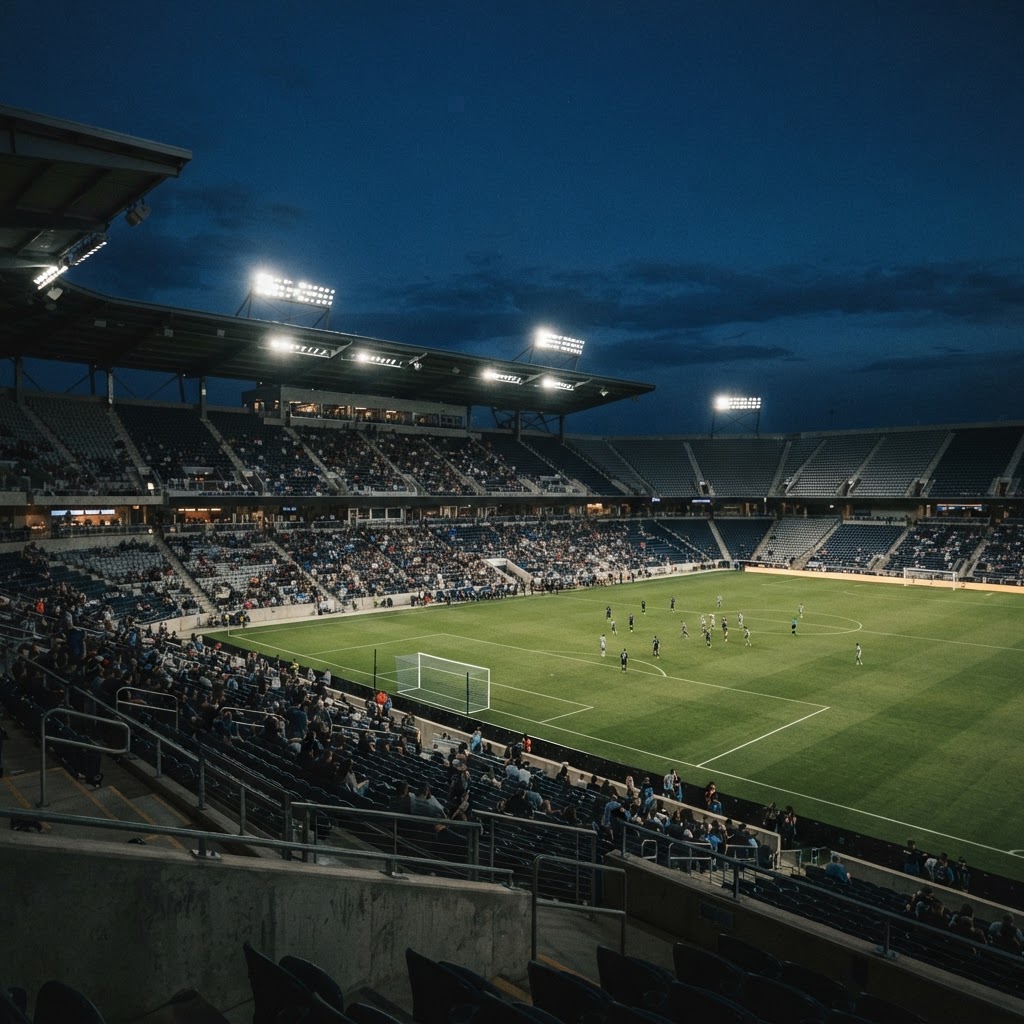
2026 USL Championship Attendance: Down 7.5%
The USL Championship average fell to 5,148 per match while MLS and USL League One grew. We checked every club figure and found venue control, not market size, predicts crowds.
Read the Report