Thought Leadership
How Edgewater Castle FC Is Building One of America's Most Authentic Community Soccer Clubs
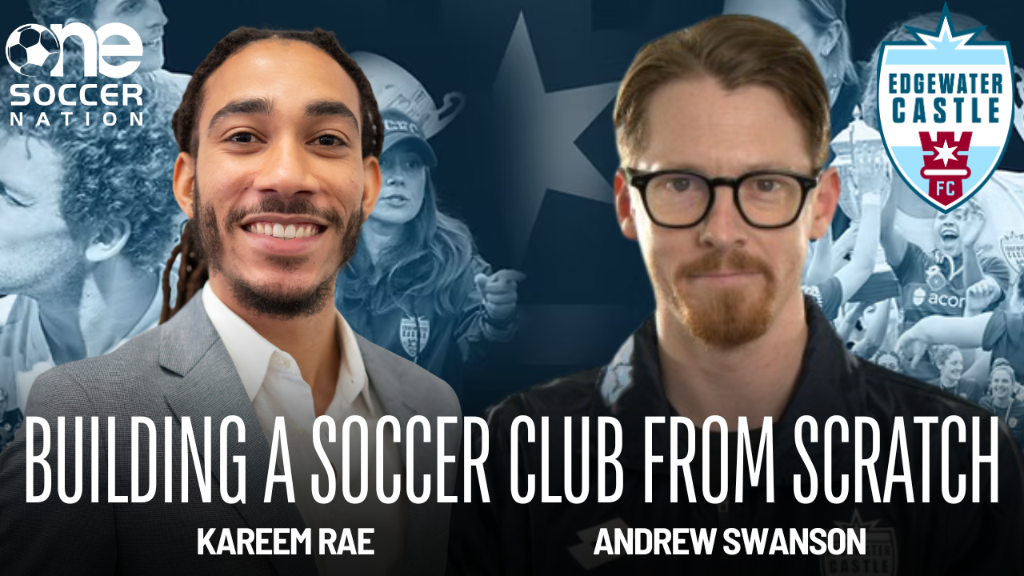
On The One Soccer Nation Podcast, Andrew Swanson, President and General Manager of Edgewater Castle Football Club, described a year of structural work most clubs never talk about publicly. In 2025, the north Chicago club launched an LLC alongside the nonprofit it had run since 2017 and closed most of an initial fundraising round tied to its next competitive step.
That can sound like the next garage-grown startup story. It is not. It is a community soccer club trying to build the financial structure required to reach the professional game without giving up the community model that made the club matter in the first place.
That is why authentic matters here. Edgewater Castle did not begin as a professional soccer project searching for a community narrative. It began as a free-to-play club, then built ownership and investment infrastructure around the trust, access, and participation it already earned.
This piece is for anyone weighing a path into USL or NWSL ownership without a facility, a league slot, or a billionaire attached. Edgewater Castle is attempting that climb in public, and Swanson was unusually specific about the mechanics.
The starting point: a club that refused the easiest revenue line
Edgewater Castle was incorporated as a nonprofit on Halloween of 2017, with first games in 2018. Swanson founded it with co-founder James Katia, who had been running local youth soccer clinics. For seven years it operated as a pure nonprofit.
The defining constraint: the club does not charge players to play. Every program, youth and adult, is free to participate in.
That single decision shapes everything downstream. It removes the revenue line most amateur and semi-pro clubs lean on, and forces the organization onto what Swanson calls more professional avenues. The club runs on sponsorship (many small community sponsors plus front-of-kit, back-of-kit, and stadium deals), ticket sales, merchandise, and advertising income. Sponsorship does the heavy lifting.
A free-to-play model is not charity positioning. It is a financing decision. It closes the player-fee door and forces the club to build three others: commercial partnerships, paying spectators, and aligned investors.
Why the LLC exists
Here is the structural move. In 2025, the club split into two entities: the original nonprofit and a new LLC. The nonprofit continues the community and youth mission. The LLC is the vehicle for ownership and investment.
Swanson was direct about the purpose. The LLC made it possible to bring in new ownership and investment specifically to fund the jump into USL League Two and USL W for the 2026 season. The club spent 2025 closing most of that first raise.
The reframe worth sitting with: the nonprofit is not the obstacle to investment. It is the asset the investment is priced against. The free youth programs, civic relationships, neighborhood trust, and national championship on the women's side are part of the value base. The LLC is the structure that lets the club convert that legitimacy into investable equity, and eventually into a credible path to professional soccer, without dismantling the community work that created it.
A nonprofit that earns community trust and an LLC that can hold equity are not in tension. The structure suggests they are designed to feed each other.
The asset-light base, and the asset-heavy problem it doesn't solve
Edgewater Castle's sustainability rests on substitution. Instead of buying or building expensive infrastructure, it trades civic value for civic resources.
The mechanism is concrete: the club gives 2,500-plus kids per year free after-school and summer soccer, and in exchange gets access to park-owned field space to train its first teams. Swanson credits this to a civic-engagement background from his years running a theater company, which taught him who owns local resources and what they cost in money versus in partnership.
That model has a ceiling, and Swanson named it himself. Asked about the biggest hurdles to USL League One, he went straight to the venue question. Chicago is dense. Field-sized space is rare and expensive. Park access covers training. It does not deliver a League One-grade home.
So the asset-light model is real and it is working, but it solves the operating-cost problem, not the venue problem. The civic-partnership model is a genuine competitive advantage at the amateur and semi-pro rungs. It is not yet a stadium.
The next raise is the real test
The first raise funded the move the club has already made. The next raise is the one that matters, and the one still unproven.
Swanson said the club will need significantly more investment to reach USL League One. The next raise is substantially larger. It will likely bring in additional ownership at significant percentages. He described a League One budget as dramatically larger, driven mainly by paying players and staff a real wage, plus the venue requirements that come with a League One club.
Here is the risk a prospective owner should price. The League One jump is not one step change. It is several at once:
Payroll moves from volunteer-adjacent to professional, across a full first-team squad and coaching staff. Front-office functions (ticketing, marketing, operations) have to convert from talented underpaid people to paid professional departments. The venue problem has to be solved on a real timeline, in one of the densest markets in the country.
Each of those is a separate fundraising and operational bet. The B series proved the club can raise against a defined rung. The A series asks it to clear all three step-changes more or less together.
What good looks like, on Swanson's own clock
Swanson framed the urgency plainly: in his view, time is running out for it to be financially possible for a club like his to reach professional soccer at all. That is the window the staged raises are racing.
His five-to-ten-year definition of success is specific. Both a men's and women's professional club operating in north Chicago. A couple of trophies in the professional ranks. An established community stadium people can access easily. And being the only combined men's and women's pro club in Chicago, in a market whose only top-tier presence is the Fire and the Stars.
The near-term tailwind is real and time-bound. Chicago is one of the largest U.S. markets without a 2026 World Cup match, but the Fire and Stars will pause during the tournament. Lower-division clubs will not. Edgewater Castle has already scheduled many of its 2026 kickoffs at noon or 1 PM so fans can attend games and still catch World Cup matches. For one summer, a community club in a global city can be one of the only live options in town.
The staged structure only works if the climb outruns the closing window. The World Cup summer is the first test of whether the audience is there to climb toward.
Final Word
Edgewater Castle FC's story is usually told as an origin romance: a club started over a cup of coffee. The more decision-relevant story is the one Swanson actually walked through. A free-to-play nonprofit, an LLC built on top of it to hold equity, a B series to fund the rung just cleared, and an A series that has to finance payroll, front office, and a stadium at once.
For a prospective ownership group, that is the real lesson. The community work is not the soft part of the plan. It is the collateral. The hard part is whether the capital structure can be sequenced fast enough to beat the cost of entry rising to meet it.
Comments
No comments yet. Be the first to share your thoughts.