Industry Analysis
PIF Bought a Tier-3 World Cup Slot. The Bundle Is the Real Deal.
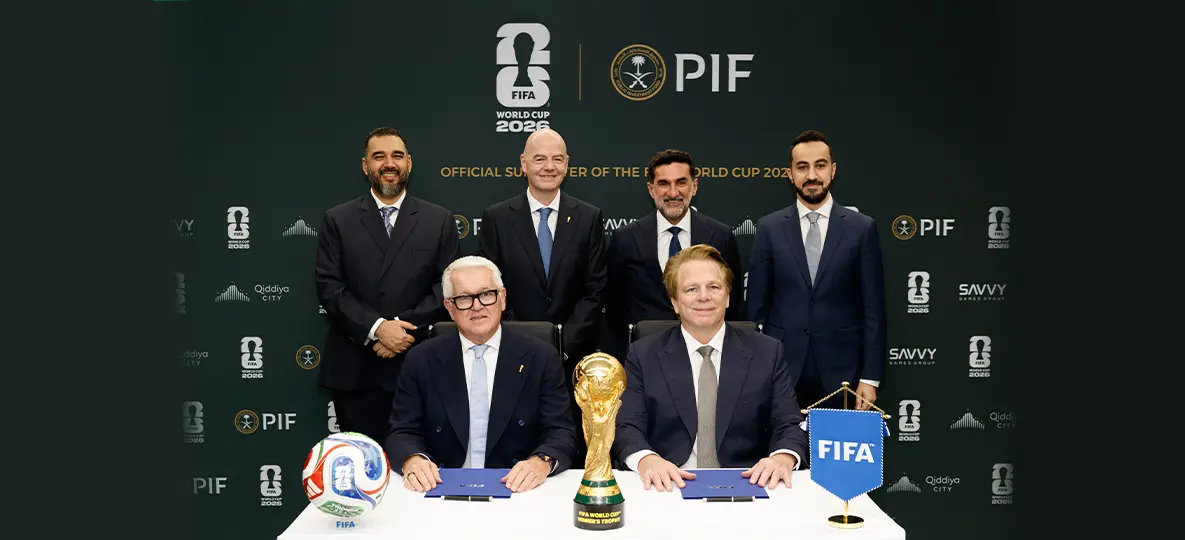
On May 14, the Public Investment Fund was named an Official Tournament Supporter of the FIFA World Cup 2026, covering North America and Asia. The headline read like another Saudi sports deal. It isn't.
The interesting facts are buried in the structure. PIF did not buy a Tier-1 FIFA Partner position, the slot Aramco, Adidas, Visa, Coca-Cola, Hyundai-Kia, Lenovo, and Qatar Airways occupy. It did not buy a Tier-2 World Cup Sponsor slot either. It took a Tier-3 regional supporter position, and it folded Savvy Games Group and Qiddiya City into the activation. That is a portfolio move dressed as a marketing deal.
This is not a sponsorship. It is a positioning trade priced against a known endpoint in 2034.
The Bigger Picture
PIF already has Saudi exposure at the top of the FIFA stack through Aramco. Buying a second top-tier slot would have produced overlap, not leverage. Taking a regional supporter position in North America and Asia adds two things Aramco does not: a tournament-specific platform in the host markets, and a wrapper that can carry PIF's operating companies onto a global stage. The two regions chosen are not random. North America is the host. Asia is Saudi Arabia's home confederation and the route to 2034. The deal hits both ends of PIF's runway in a single contract.
The Vision 2030 framing makes this explicit. PIF stated the partnership sits inside the tourism, leisure, and entertainment ecosystem of its 2026 to 2030 strategy. That language matters. Sport is not being treated as a standalone vertical. It is being treated as a distribution channel for the rest of the portfolio.
1. The Tier Choice Is the First Signal
FIFA's commercial hierarchy is well-defined. Tier 1 Partners hold global rights across all FIFA competitions for the full cycle. Tier 2 sponsors hold global rights tied to a single tournament. Tier 3 Tournament Supporters operate within specific regions or service categories. Industry estimates put Tier 2 World Cup deals in the range of 65 to 95 million dollars per sponsor, though primary FIFA figures are not disclosed.
PIF skipped both global tiers. A fund managing reported assets in the range of 925 billion dollars, with stated ambition to reach two to three trillion by 2030, did not buy on capacity. It bought on fit.
The structure suggests three things. A regional slot scoped to North America and Asia is cheaper than a global one, which preserves dry powder for the much larger 2034 hosting commitment. A regional slot also avoids competition with Aramco's existing Tier-1 position. And a regional slot is geographically targeted at exactly the two markets PIF most needs to influence before 2034: the tournament's current host region and its own confederation.
If you measure influence by tier ranking, this looks like a step down. If you measure it by capital efficiency per region of strategic interest, it looks deliberate.
2. The Bundle Is the Second Signal
PIF folded Savvy Games Group, its esports and gaming holding, and Qiddiya City, the future entertainment and sports district outside Riyadh, into the partnership. Standard FIFA sponsorship deals do not typically carry two operating companies inside them. This one does.
That bundling does work most sponsorships cannot.
Savvy Games gets a global activation surface for esports tied to a live football audience, accelerating its positioning as a route into football-adjacent gaming for a generation that consumes both interchangeably. Qiddiya City gets pre-2034 brand placement at the largest football event ever staged, building name recognition with the operators, sponsors, and infrastructure partners it will eventually need to host visiting delegations. PIF itself gets a single contract that creates pull-through marketing for two of its operating businesses without buying them each their own sponsorship.
The activation is the asset. The sponsorship is the wrapper.
This is what mature sovereign sports portfolios look like. They stop buying individual placements for individual brands and start buying platforms that carry multiple holdings simultaneously. PIF's prior FIFA Club World Cup 2025 partnership and its SURJ Sports Investment stake in DAZN are part of the same logic. Each deal is a node, not a transaction.
3. The Counterargument Deserves Air
There is a sharper read available, and the analysis is weaker if it isn't addressed.
FIFA reportedly confirmed in March 2026 that all 16 global sponsorship positions were filled, with only regional slots remaining. If that is accurate, PIF's tier choice was not a strategic preference. It was the only inventory available. The "deliberate positioning" read becomes a rationalization of a constrained outcome.
This is a fair challenge, and it is partially true. Tier 1 and Tier 2 may indeed have been closed. But the bundling decision was not constrained. PIF chose to attach Savvy Games and Qiddiya to a regional supporter contract. It could have left them out. It could have done a clean PIF-branded deal. The fact that two operating companies were folded into the activation is a portfolio-strategy decision that exists independent of which tier was available. The constraint argument explains the tier. It does not explain the bundle.
The tier may be a function of FIFA inventory. The architecture is a function of PIF design.
4. What This Tells Institutional Investors
The deal architecture is portable. Strip the Saudi context and the underlying pattern is what sophisticated sports capital now looks like, regardless of source.
Sponsorship dollars increasingly buy platform activation for adjacent holdings, not standalone brand exposure. Regional positioning, priced correctly, can deliver more strategic value in target markets than global positioning bought at multiples of the price. Sovereign and institutional capital with a known terminal event (a host year, a fund maturity, a flagship project opening) prices intermediate deals against that endpoint, which often justifies positions that look suboptimal on conventional sponsorship ROI metrics.
For LPs evaluating sports allocations, the read-through is direct. The question to ask of any sports investment is no longer "what is the brand exposure," it is "what other holdings does this activation pull through, and on what runway."
What This Signals About the Broader Strategy
PIF is no longer accumulating football positions. It is now connecting the ones it has. Newcastle United in the Premier League. Four Saudi Pro League clubs holding majority PIF stakes. A SURJ Sports stake in DAZN. The FIFA Club World Cup 2025 partnership. Now a FIFA World Cup 2026 regional supporter slot with two operating companies attached.
Each individual piece has been covered to exhaustion. The connections between them have not. The shift from acquisition to integration is the substantive story, and this deal is the first one to make the integration architecture visible inside a single contract.
What Investors and Operators Should Watch
Whether PIF announces additional FIFA-linked activations between now and the 2027 Asian Cup that further bundle Qiddiya or Savvy assets, which would confirm the platform read. Whether the regional scope expands to other confederations before 2034, particularly CONMEBOL given Al-Rumayyan's stated interest in Brazilian football investment. Whether other sovereign or institutional sports investors begin replicating the bundled-supporter structure, which would mark the deal as a template rather than a one-off. Whether FIFA continues offering regional-only tiers post-2026, since the success of these deals will shape commercial architecture for 2030 and beyond. Movement in Saudi Pro League club valuations and competitive balance, which is the domestic test of whether the integration strategy is producing returns or just visibility.
Final Thought
The tier was the cheapest part of this deal. The bundle is what was actually purchased. Sovereign capital is no longer paying for placement. It is paying for platforms that carry the rest of the book.
The clubs, leagues, and cities that understand the difference will write better deals. The ones that don't will keep selling logos.
Comments
No comments yet. Be the first to share your thoughts.