Club Ownership
How the USL Is Building the Future of American Soccer One Stadium District at a Time
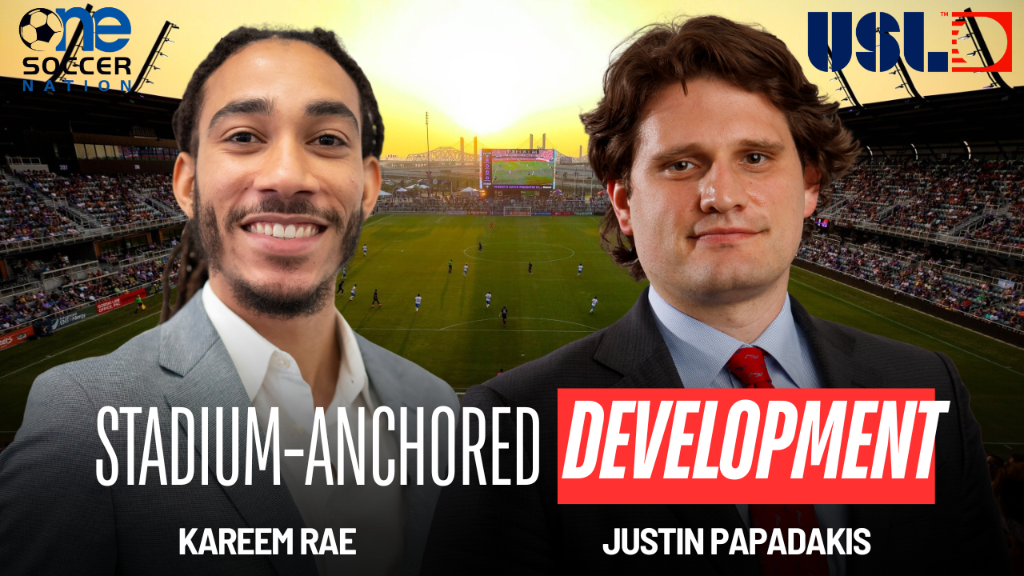
In my recent conversation with Justin Papadakis, Deputy CEO & Chief Real Estate Officer at the United Soccer League (USL), one thing became crystal clear: the USL is not just launching clubs. It's building the infrastructure and real estate engine that will shape the next era of American soccer.
From stadium-anchored districts to world-class training centers and a bold commitment to the women's game, Justin laid out a vision that goes far beyond what happens in 90 minutes on match day.
From Winnipeg to World Cups: Why Soccer Is Personal
Justin's connection to the game starts at home. His father, USL CEO Alec Papadakis, grew up poor in Greece, moved to Winnipeg, Canada, and used his talent in soccer to earn opportunities in high school, college, and eventually law school by coaching the team. That story of football literally changing the trajectory of a family is what shaped Justin's lens on the sport.
Justin played growing up, spent time at Benfica in Portugal during high school, then played at Duke University before going into real estate. In 2008, his family acquired the USL. By 2015 he joined full-time, just as the league's national growth began to accelerate. That mix of soccer DNA and real estate expertise is exactly what's driving the USL's current expansion model.
2025-2026: The Biggest Inflection Point Yet
The USL is building into a moment. Between the expanded 2025 FIFA Club World Cup in the U.S., the 2026 Men's World Cup hosted by Canada, the U.S., and Mexico, the 2028 Olympics in Los Angeles, and the upcoming Women's Club World Cup North America is about to live through the most concentrated run of global football events in its history.
Justin sees 2025 as the major inflection year when years of groundwork in stadiums, clubs, and development converge with a global spotlight and surging domestic interest.
Stadium-Anchored Development: Community Living Rooms, Not Just Venues
If there's one phrase Justin repeats, it's "stadium-anchored development." Unlike Europe, where clubs inherited century-old grounds, U.S. soccer has to build everything from scratch the stadiums, districts, and training centers. The USL has leaned into that challenge by treating stadiums as anchors for wider mixed-use projects (residential, retail, hotel, entertainment) and community living rooms where the entire city can come together around one club and one identity.
Justin and the USL real estate team are currently working with 70+ cities on stadium projects, often for 5-10 years before a club is even announced. The model is deliberate: start with the city, identify a strategic site that can unlock underused land, structure the stadium district through entitlements, zoning, infrastructure, and financing, then place ownership by bringing in a local group to run the club once the hard real estate work is largely de-risked.
It's slow, it's complex, and it's exactly why we're now seeing what feels like "overnight" announcements of new USL markets years in the making.
Training Centers: Where the Real Work Happens
Most of the conversation in U.S. soccer has historically centered around stadiums. Justin is clear: that's only half the picture. The USL is now driving hundreds of millions of dollars into training centers and what he calls "the players' office." Over the next five years, USL clubs are expected to invest at least $500 million into high-performance facilities, many co-located with hospitals and other commercial partners to make the projects sustainable.
These facilities put players in professional environments every day, integrate pros and youth in the same ecosystem with shared fields, gyms, and cafeterias, and create the conditions to develop and sell players not just sign them. That's critical, because in most top clubs around the world, player transfers are a top 2-4 revenue line. In USL, valuations are already crossing the $50-100 million mark before recurring transfer revenue is fully built in.
Right now, players are still often treated as expenses. Justin's thesis is that USL is moving toward a world where they're treated as assets, which in turn justifies bigger investments in coaching, sports science, and infrastructure.
Working With Cities: From Baseball Towns to Soccer Towns
One of the most underrated parts of the USL story is political. When Justin started pitching projects to mayors and city managers years ago, most of them came from a baseball or American football mindset. Over time, that leadership class has been replaced by people who played soccer growing up, or have kids in the game.
Cities today are competing for talent and young professionals, looking for quality-of-life assets that make people want to stay, and increasingly aware that every match is a two-hour commercial for their city. That's why many municipalities are now partnering with the USL on stadium-anchored entertainment districts, often using tax increment financing and adjacent real estate to help support the stadium piece of the capital stack.
Why Local Ownership Still Matters
USL's model is not "real estate first, flip the asset later." Local ownership is still central. Most clubs now have 10-30 partners, bringing together leaders from tech, real estate, healthcare, finance, and other sectors under a shared mission to build a club that matters on and off the pitch.
Justin calls that network one of the league's superpowers: clubs compete on the field, but off the field, owners share knowledge, relationships, and capital. Each new club adds another web of connectors to the overall ecosystem. This is how you go from a handful of clubs to a nationwide pyramid in a short window of time.
The USL Super League: A Serious Play in Women's Football
The launch of the USL Super League as a Division I women's league is not a token gesture it's a structural bet. The U.S. already has the best pool of women's players in the world, but historically only a few hundred professional spots. The USL aims to 5x the number of pro opportunities over the next several years.
The strategy is almost identical to the men's side: stadium-anchored districts with proper hospitality and premium spaces, professional-grade training centers, strong local ownership and municipal backing, and a commercial platform including a Peacock broadcast partnership that treats the women's game as a serious product, not an afterthought. The long-term ambition? Compete for and win the Women's Club World Cup once it launches.
Jobs, Pathways, and a Message to the Next Generation
One of the most powerful parts of our conversation came when we shifted from clubs and cities to careers. The percentage of players who will make it as pros on the field is tiny. But the USL ecosystem alone will generate thousands of front office jobs across marketing and content, sales and partnerships, operations and events, finance, data, and analytics, and facility and real estate operations.
Because the USL is still in a high-growth phase adding leagues, clubs, and departments young professionals can gain responsibility and upward mobility far faster than in more mature leagues. For anyone who loves the game but may not be in the top 1% on the pitch, Justin's message is simple: you can build a real career in soccer helping shape a club's identity, impact a community, and grow the sport without ever stepping on the field as a pro.
Final Thoughts
What the USL is doing under Justin's leadership on the real estate and strategy side goes way beyond expansion announcements. It's about building permanent soccer infrastructure in markets that have never had it, turning stadiums into community living rooms and economic engines, elevating training centers so American players can compete globally, creating a true pyramid with real pathways for players, clubs, and professionals, and positioning the league to ride the wave of 2025-2026 and beyond.
If you're an investor, city leader, club operator, or young professional trying to understand where the game is heading in North America, the USL story and Justin's work on stadium-anchored development is one you should be paying close attention to.
Listen to the full episode
Free Industry Report
2026 USL Championship Attendance: Down 7.5%
The USL Championship average fell to 5,148 per match while MLS and USL League One grew. We checked every club figure and found venue control, not market size, predicts crowds.
Read the Report