Club Ownership
Chris Martinovic Co-Founder of Ozark United FC | Building a Soccer Legacy in Northwest Arkansas
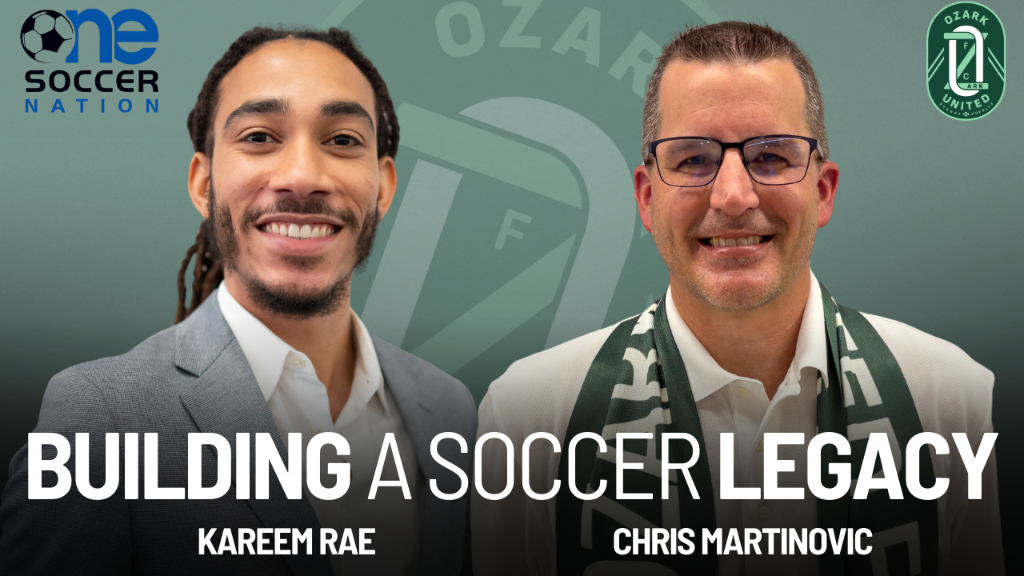
Chris Martinovic's story starts in Queens, New York, in a Croatian immigrant household where money was tight but community and sport were abundant. His father knew two sports: soccer and basketball. That was enough.
Growing up in that environment, Chris experienced soccer as more than competition it was culture, family, noise, and identity. Then at Seton Hall University, he played under legendary coach Manfred Schellscheidt, often called the godfather of United States coaching in the Northeast. Manfred repeated a line that never left him: "The things you love will love you back."
Years later, that quote sits at the center of Ozark United FC.
Discovering Northwest Arkansas: Hotel California For High Performers
In 2006, a career opportunity with Bayer and a major Walmart account took Chris and his young family from New Jersey to Northwest Arkansas. At the time, he thought it might be an eighteen-month assignment. It turned into a long-term commitment.
The region is anchored by companies such as Walmart, Tyson, and JB Hunt. Over time, suppliers followed. Global brands opened full-scale offices to service the retail giant. The result is a concentration of talent that feels more like a rising metro than a traditional small town. People arrive intending to stay temporarily, then fall in love with the community, quality of life, and opportunity. Locals call it Hotel California: once you check in, you rarely leave.
The region is one of the fastest-growing in the country, with dozens of new residents arriving daily. Corporate families like the Waltons, Tysons, and Hunts invest heavily in arts, culture, cycling, and public space. World-class assets such as Crystal Bridges Museum give the area a unique blend of small-town warmth and big-city ambition.
But despite all that momentum, there was no professional sports team. Families like Chris's were regularly driving to Kansas City, Dallas, Tulsa, Oklahoma City, Memphis, and Saint Louis to get the professional game-day experience. Over time, Chris realized he was not the only one making that drive. That gap became the opportunity.
From "Crazy Idea" to Concrete Project
In 2019, Chris took the idea that had been growing quietly in his mind and finally said it out loud. He picked up the phone and called Jake Edwards, then President of the United Soccer League, and a longtime friend from their days together in New Jersey.
At first, Jake was skeptical. But Chris did what good operators do he gathered data, built the case, and came back with a clearer picture of the market, its growth, and its corporate base. That effort opened the door.
From there, the work became more complex and more real: understanding where a stadium could realistically go, testing investor interest, feeling out the corporate partner landscape, and listening to the community before deciding on name, colors, and crest.
The Hardest Question: Where Will You Play?
Ask anyone who has tried to launch a professional team in the United States. One question dwarfs the rest: where are you going to play?
For Ozark United FC, the answer was never going to be a temporary or second-tier solution. Chris and his partner Warren Smith agreed early on that if they were going to do this, they would do it at A level. That meant working toward a location in Pinnacle Hills the entertainment district of Northwest Arkansas with a stadium starting at around 5,000 seats expandable toward 15,000 or more, and enough land to support mixed-use development around the stadium.
The process was not simple. At one stage, the group had controlled land in Pinnacle Hills but eventually had to step back, re-evaluate, and work with local real estate partners to assemble approximately 38 acres across multiple landowners near their original target zone. Today, that land assembly and stadium plan is one of the biggest risk reducers in the entire project. It positions Ozark United FC not just as a tenant, but as a central piece of a larger district.
De-Risking the Project for the Long Term
Chris is clear: passion alone does not make a club sustainable. The numbers have to work. From his business background and Warren's track record, they focused on three major pillars.
Ticketing and matchday demand: with more than 10,000 people already in their database well in advance of their first game, Ozark United FC has early proof of demand. For most USL clubs, ticketing and matchday revenue represent a major share of annual income. Showing a deep, engaged list before a ball is kicked gives investors confidence the stadium will not be empty.
Sponsorship and partnerships: Northwest Arkansas is uniquely positioned. The region is full of major consumer brands, suppliers, and growth companies already highly engaged in community giving and activation. The goal is a sponsorship pipeline strong enough to cover a large portion of operating expenses and reinvest into the sport.
Real estate and mixed-use value: the larger site enables residential and hospitality opportunities, food, beverage, and retail offerings, and year-round activation that keeps the area alive beyond matchdays. Partnering with an experienced national developer allows the club to focus on soccer and community while experts shape the broader district.
Building the Pathway: Youth, Identity, and Opportunity
Ozark United FC has launched an academy program with boys teams from U13 to U19 competing in MLS NEXT, one of the highest levels of youth competition in the United States. Local players now get the kind of exposure and level of play that used to require moving away. The club has attracted high-level coaches with college and professional experience, and young players are already being recognized at national identification camps.
The club listened to the community in shaping its identity. Through listening sessions, surveys, and open dialogue, they landed on the name Ozark United FC. The "United" reflects a deeper reality the project is designed to represent Bentonville, Rogers, Springdale, Fayetteville, and surrounding communities together, not one city against another.
The Women's Game and Retaining Local Talent
Northwest Arkansas already has a strong women's soccer presence, led by the University of Arkansas women's program which regularly ranks among the top teams nationally. Ozark United FC's vision includes launching both men's and women's professional teams, with the women aligning into the USL Super League timeline. The strategic goal: give local women's players a professional pathway without leaving the region and build on existing fan culture around women's soccer.
Community Moments That Show the Future
Beyond boardrooms and spreadsheets, the power of the project shows up in small moments: pickup games where kids set up impromptu matches using garbage cans as goals and shout "Ozark United" when they recognize the brand; the Outrigger Cup, where the Marshall Islands national team played its first-ever official match in Springdale surrounded by a large local Marshallese community; and the Hellbenders the supporters group that has already formed, complete with leadership structure, chants, and a growing presence at soccer events in the region.
Ten Years From Now
When Chris looks ten years ahead, his answer is less about league tables and more about impact. He wants Ozark United FC to stand for a community proud of its club and its region, a gateway to the game for kids who otherwise would not have had a path, and a reason for people to stay in Northwest Arkansas and see themselves reflected in the stands and on the pitch.
Ozark United FC is not just launching a team. It is helping a fast-growing region decide what kind of sports culture it wants to build.
Listen to the full episode
Comments
No comments yet. Be the first to share your thoughts.